SMF vs. MMF: Unraveling the Differences in Fiber Optic Cables

Understanding the Basics
- Single-mode fiber (SMF)
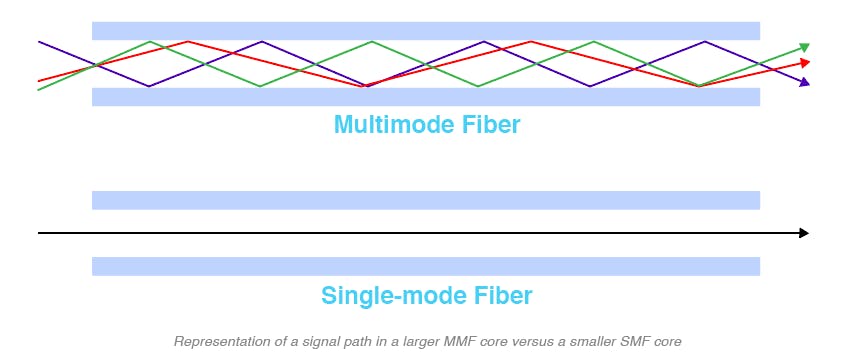
As the name implies, single-mode fiber permits just one mode of light to pass through the core of the cable. The core diameter is usually less than 8–10 micrometers. This design reduces light signal dispersion, resulting in greater signal quality and longer transmission lengths. SMF is often used in long-distance applications where data must travel great distances without deteriorating in quality.
- Multi-Mode Fiber (MMF)
Multi-Mode fiber, on the other hand, has a greater core diameter, often 50 or 62.5 micrometers. This bigger core allows various modes of light to move at the same time. While this enables simpler and less expensive transmitter and receiver equipment, it also adds modal dispersion, which limits the maximum distance data may travel without signal deterioration. MMF is frequently preferred for shorter-distance travel.
Performance Comparison
- Data Transmission Distance
SMF takes the lead in terms of transmission distance. Due to its reduced dispersion, it can transmit data over much longer distances compared to MMF. This makes SMF the go-to choice for intercontinental data transmission and long-distance communication networks.
- Bandwidth
MMF shines when it comes to bandwidth capacity for short distances. The larger core diameter allows for multiple light rays to bounce off the core's walls, providing greater capacity for data transmission over short spans. In scenarios where high bandwidth is required within confined spaces, MMF is the preferred choice.
Factors Influencing Choice
- Distance Requirements
In terms of transmission distance, SMF takes the lead. It can transport data over far greater distances than MMF due to its lower dispersion. As a result, SMF is the preferred protocol for intercontinental data transmission and long-distance communication networks.
- Budget Considerations
MMF excels in terms of bandwidth capacity at short distances. The increased core diameter allows several light beams to bounce off the core's walls, increasing data transmission capacity over short distances. MMF is the preferable option when high bandwidth is required in limited places.
- Future-Proofing
It is critical to anticipate future technological breakthroughs. If you're planning to invest in a network that will need to support larger data rates and increased bandwidth demands, SMF offers a more future-proof solution, ensuring your infrastructure can handle changing needs.
Making the Right Choice
Finally, the decision between SMF and MMF comes down to your unique needs. Each type of fiber optic cable has advantages and disadvantages that make it suitable for different applications. You may make an informed decision that corresponds with your present demands and future growth by evaluating criteria like distance, money, and scalability.
.jpg)


Comments
Post a Comment